
Collaboration

Eine Illustration mit zwei Menschen, die gerahmt sind von Symbolen die den Denkprozess verdeutlichen - Sprechblase, Glühbirne und Zahnräder.
Reflection & Evaluation in COIL Projects
In the final phase of a COIL project, students come together, present, and reflect on their results. They look back on their academic insights as well as the experience of international collaboration, making their joint achievements visible. At the same time, instructors evaluate the project academically, organizationally, and interculturally. This phase is essential for ensuring…
Carrying Out Your COIL Project
This is the stage where planning turns into practice: students from both institutions finally meet, start working together, and build their joint learning experience. The focus lies on launching the collaboration smoothly, creating trust, and guiding students through meaningful international teamwork.
Designing Your COIL Course
Once your course and institutional partner are confirmed, it’s time to co-develop your COIL project. In this phase, you and your partner will shape the course structure, activities, and timeline: What content will you cover? What kind of student collaboration is appropriate? And how can the courses at both institutions be meaningfully aligned? The goal…
Setting Up a Collaborative Online International Learning Project
The first step in creating a COIL (Collaborative Online International Learning) project is identifying a suitable course and a partner that aligns with your academic goals. A well-matched collaboration enhances student learning by integrating diverse perspectives, interdisciplinary approaches, and real-world problem-solving. When establishing a cooperation with a teaching partner, it is important to agree on…
COIL: Internationalize Your Teaching Through Virtual Collaboration 
Looking to bring global perspectives into your lectures—without organizing a study abroad program? COIL (Collaborative Online International Learning) is a flexible and low-barrier way to internationalize your teaching. By teaming up with an international partner, you guide students through shared, virtual projects that build intercultural skills, digital fluency, and subject knowledge. This page introduces a…
Open thinking, networking, and developing joint solutions at HIP
The University’s Interdisciplinary Project Week is an established digital format for interdisciplinary collaboration beyond faculty and subject boundaries. Students learn to operate in heterogeneous teams and develop an understanding of methods from other disciplines. Their task is to develop a project idea thematically linked to the respective Science Year. The central element is the methodically…
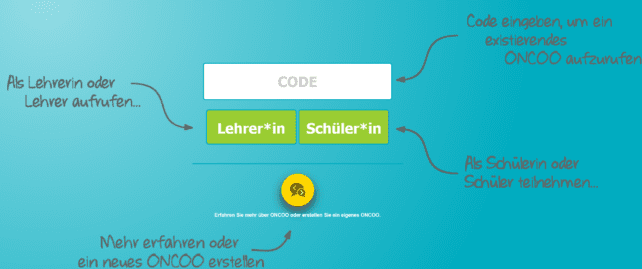
Bildschirmfoto der Startseite von Oncoo mit den Möglichkeiten:, „Code eingeben, um ein existierendes Oncoo aufzurufen“, „Als Lehrer*in oder Lehrer aufrufen“, „Als Schülerin oder Schüler teilnehmen“ oder „Mehr erfahren oder ein neues Oncoo zu erstellen“.
ONCOO
The digital toolbox ONCOO offers you different methods for collaborative and interactive learning. From brainstorming to evaluation, it allows you to actively involve your students in the course. We will show you how the tool works.
Bildschirmfoto einer ausführlich angelegten Pinnwand von TaskCards. Verschiedene Elemente wie Texte, Bilder, Videos, Kontaktkarten, Videokonferenzen und Links sind auf den Karten und nach Oberbegriffen sortiert  hinterlegt.
TaskCards
How do I provide well-structured learning materials, and how can I organize them digitally so that students can quickly find their way around? Help is provided by the online platform TaskCards, which can be used to sort and clearly display learning content, information, or deadlines.
Bildschirmfoto der verschiedenen Vorlagen für ein Padlet: „Wand“, „Leindwand“, „Liste“, „Storyboard“, „Regal“, „Unterhaltung“, „Karte“, „Timeline“.
Padlet
Padlet is a collaborative web platform that allows you collect information from various sources. With Padlet, students participate actively by sharing notes, links, images, and videos—collaborative work becomes child’s play. Learn how you can use the tool to involve students more, but also how you can use Padlet for your own work organization.

We appreciate your feedback!

When developing this offer, we tried to include you as a teacher in advance. We would therefore be delighted if you would help us to further improve our offer. Please let us know what you would like, what bothers you or what you particularly like.

Would you like to contact us directly? Then write to us at lehrpfade@th-koeln.de!