

Inclusive Education Through Gaming: Beyond the Chalkboard in Practice
Learn about the needs of students with mental illnesses and raise awareness among educators at your university! The serious game Beyond the Chalkboard (BtC) can be integrated into workshops for higher education didactics to draw attention to accessibility issues at universities. Interested in working with BtC? Play the game yourself first. Afterwards, this article serves as a guide and offers suggestions on how to use the computer game in higher education didactics.
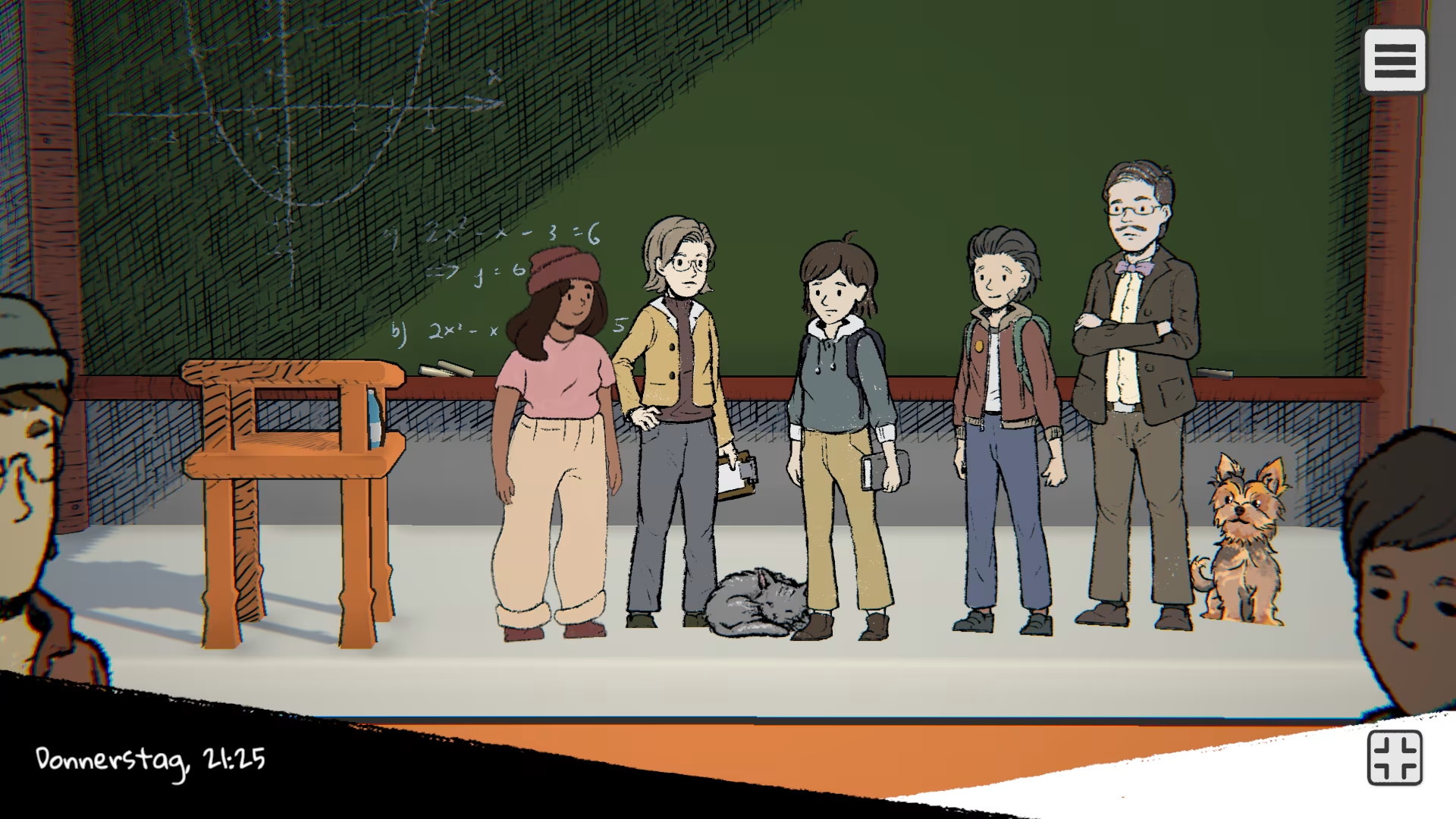
Note: This text contains information that reveals game content in advance.
A Short Introduction: How Does the Guide Work?
The guide is based on the concept of game-based learning. Besides playing the game, debriefing is essential. This term refers to a follow-up discussion, that aims to connect the gaming experience with learning (Pivec et al., 2003, p. 218). Debriefing follows the steps of experiential learning. It is about making experiences perceivable and applicable (Kolb & Yeganeh, 2011, pp. 3f.).
On this page, you will find a content overview of BtC and a proposal for how a workshop, into which the game is integrated, could be designed. The workshop’s elements can be adjusted in length by using different methods, as shown in the guide.
The guide is completed by information on the BtC website. Together, both websites provide you with all the incentives to use Beyond the Chalkboard in a setting of higher education didactics.
Game Content of Beyond the Chalkboard
Players of Beyond the Chalkboard design their teaching free of barriers by
- Recognizing the challenges of studying with a mental illness,
- reflecting on their influence on accessibility,
- understanding how barriers are systemic rather than individual, and
- engaging with accessible teaching arrangements,
to help shape an inclusive university environment for people with mental illnesses.
In BtC, you play as the protagonist Sam and experience a perspective of students with mental illnesses. Across three in-game days, different aspects of student life are covered: social life, exams, self-organization, and group work.
A central game mechanic is the “thought world,” where Sam’s thoughts and feelings collect. Sam’s thoughts must be organized to perform actions in the game. Decisions that are made in game affect Sam’s feelings and the progression of the story. For example, fog may develop in Sam’s mind and the worse Sam feels, the larger the foggy area becomes. Thoughts in the fog are harder to access. Furthermore, the fog’s color can change from light to dark, which renders some thoughts completely inaccessible. The complexity of Sam’s inner world is also illustrated by three properties of the thoughts and feelings inside Sam’s mind:
- Size: The sizes of the thoughts differ, depending on the subjective importance that Sam attaches to them. The size of a thought can change during the game. Forgetfulness can be caused by larger thoughts covering smaller ones.
- Weight: The fog influences access to thoughts. Thoughts inside the fog must be actively dragged to the front with the mouse. Heavier thoughts are harder to move. Negative or stressful thoughts are sluggish or immobile.
- Acuteness: Thoughts can also move by themselves. Negative thoughts may push themselves toward the front of Sam’s brain, depending on the situation, limiting space for other thoughts.
The game can lead to one of three possible endings. The outcome depends on the decisions made earlier in the game:
- Withdrawal
Sam stays in the apartment with minimal further interactions. At the end, a concerned message from Sam’s friend Luis flashes up. This ending occurs if social contacts are maintained hardly or not at all.
- Breakdown
Sam goes to the university but takes in very little and ends up sitting alone on the benches. This ending results from low success at university.
- Call for Help
Sam opens up to Elli and Saba and seeks out support. At the end, Sam stands at the window and a positive message from Luis flashes up. This ending occurs when Sam maintains contact with other characters and opens up.
The Workshop in Elements
The workshop lasts a full day (approx. 6 hours) and is designed for 5 to 30 participants. We recommend keeping accessibility in mind while planning! For shorter sessions, notes are provided in each element. We suggest conducting the workshop in person.
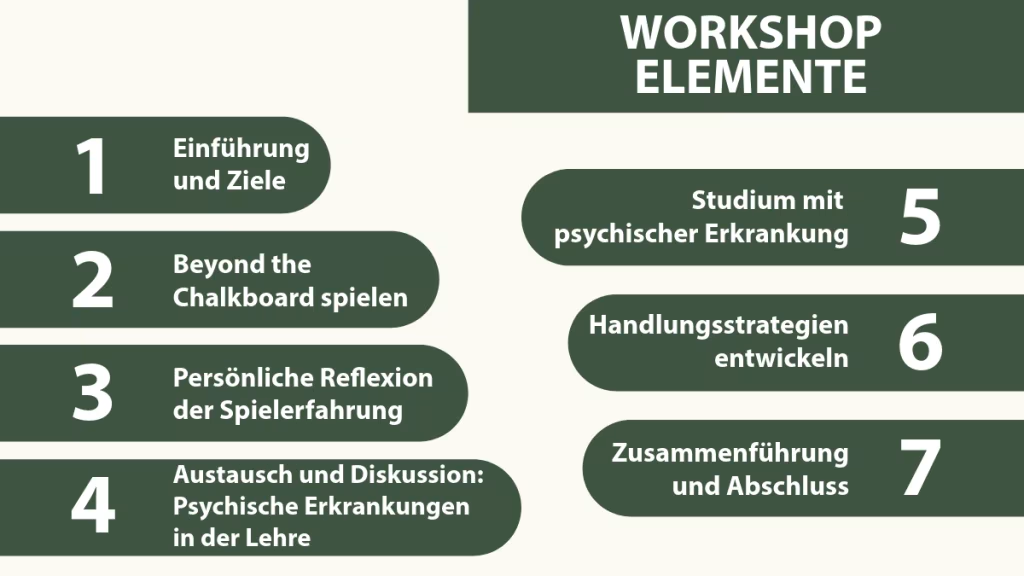
Duration: 30 minutes
Description: After a greeting, the workshop goals and schedule are presented, followed by a round of introductions where participants state their field and whether they have any connection to the topic. This can be shortened if time is tight.
Duration: 25 – 60 minutes
Description: BtC is a single-player game and participants should all play the game individually. All participants need a PC with mouse and headphones. It would be ideal to give participants time until all have reached the ending. Faster players can restart to explore other options. Be aware that the game can be emotionally challenging – inform participants accordingly.
Shorter version: BtC can be played before the workshop. Questions for reflection (see Element 3) can be given in advance.
Duration: 45 minutes
Description: Participants reflect on their experience individually.
Timeline:
- Schriftliche Einzelreflexion zu Impulsfragen
- What did you feel during the game? Were there moments of particularly strong emotion?
- Did you recognize yourself in any characters?
- Do you have any unanswered questions?
- Exchange in small groups
- Quick sharing session in the whole group
Shorter version: Depending on time, select only one or two questions or skip step 3.
Duration: 60 minutes
Description: Focus on sharing experiences. In this Element Participants connect their personal gaming experience with their teaching knowledge.
Timeline:
- Introduction to invisible disabilities (e.g., via presentation)
- Speed dating discussion on the topic: Have you had experiences with students with mental illnesses? What barriers did you encounter? Did the game change your perspective?
- Group discussion (e.g., Fish Bowl):
- How can I address individual needs while still providing good teaching for all students?
- What barriers do students with mental illness face
Shorter version: Limit the element to either point 2 or 3.
Duration: 30 minutes
Description: The focus here lies on support services at your university. The given examples must be adapted to your institution. In this element you also have the possibility to convey basic knowledge about mental illnesses.
Timeline:
- Overview of support options at your university (e.g. via a quiz)
- Group research on inclusive studying and support services at your university
- Information slides
- Contacts and offices (office for students with mental illnesses, student council, …)
- Compensation for disadvantages
Shorter version: Only present an overview of support options at your university.
Duration: 45 – 60 minutes
Description: Based on their game experience and prior exchange, Participants reflect on barriers in their teaching. They discuss steps to reduce barriers and set personal goals. This element is crucial and can therefore not be shortened. But the length of the group work can be adjusted.
Timeline:
- Form small groups
- Sams Situation im Spiel ist belastend. Welche Hindernisse sind Ihnen besonders aufgefallen?
- Imagine an ideal inclusive scenario for students with mental illnesses: How can barriers be reduced? How can exams, seminar communication, and group work be adjusted to cause less stress?
- Collect ideas on cards
- Presentation of ideas to the group
- Formulieren von möglichen persönlichen nächsten Schritten in Einzelarbeit. Dazu beantworten die Teilnehmenden die Fragen schriftlich für sich: Was heißt das konkret für meine Lehre? Was möchte ich als nächstes umsetzen? Wenn Zeit bleibt, können die Teilnehmenden dazu eingeladen werden, Ideen zu teilen, müssen dies aber nicht. Als Hilfestellung können konkretere Fragen nachgereicht werden:
- What else would I like to learn?
- How do I design my teaching sessions?
- How do I design my digital teaching?
- How do I engage with students?
Duration: 20 – 30 minutes
Description: Discuss key insights from the workshop and unanswered questions. Finish with a feedback round. This element can be shortened or extended depending on the time.
Timeline:
- Summary of the workshop
- Give clarification regarding unanswered questions and provide pointers to further resources
- Feedback round
Give us Feedback!
Thank you for engaging with Beyond the Chalkboard! We would appreciate you giving us feedback on this website.
Any questions?
Feel free to contact us by mail to lehrpfade@th-koeln.de!
Links & Literature
- Pivec, M., Dziabenko, O., & Schinnerl, I. (2003). Aspects of Game-Based Learning.
- Yenganeh, B. & Kolb, D. A. (2011). Deliberate Experiential Learning. Mastering the Art of Learning from Experience. ORBH Working Paper Case Western Reserve Universtiy.
- Beyond the Chalkboard auf der TH-Webseite
- Lehrpfade-Article “Accessible Teaching”
- Insight into the study life of students with disabilities and specific recommendations at: Barrier-Free Blind Date
- Direct link to a student with mental illness: Maxi – Barrierefreies Blinddate
Header-Bild: Beyond the Chalkboard (ZLE)
-

Dr. Klara Groß-Elixmann is a research assistant at the Center for Academic Development at TH Köln. She coordinates TAPs at TH Köln in collaboration with the University Department for Quality Management. She also designs the "Barrier-free teaching" project and organizes the university didactic training programme.
-

-