
Feedback

An illustration featuring two people framed by symbols that represent the thought process—a speech bubble, a light bulb, and gears.
Reflection & Evaluation in COIL Projects
In the final phase of a COIL project, students come together, present, and reflect on their results. They look back on their academic insights as well as the experience of international collaboration, making their joint achievements visible. At the same time, instructors evaluate the project academically, organizationally, and interculturally. This phase is essential for ensuring…

Photo. Various learning materials are spread out on a table. The hands of two people are interacting with the materials.
Peer Tutoring – Students Support Students
With peer-to-peer tutoring from students for students, the services of the Writing Center have been expanded to include a particularly low-threshold format. But what exactly is behind it – and how does peer tutoring complement the teaching and learning culture at TH Köln?
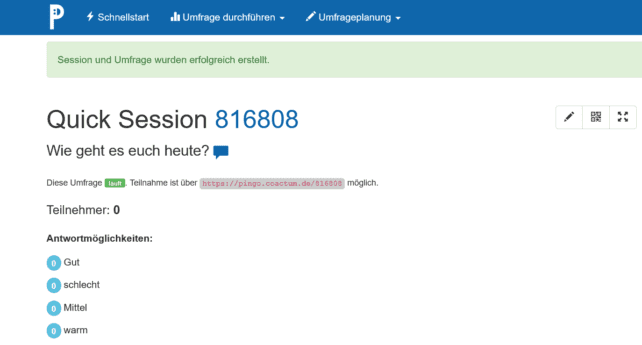
Screenshot of the PINGO app. A poll has been created, and the number of participants and the number of answer options selected are visible.
PINGO
Have your students submit feedback or answer questions immediately. The real-time feedback system PINGO allows you to actively involve students in your course. We will show you how to use the tool.
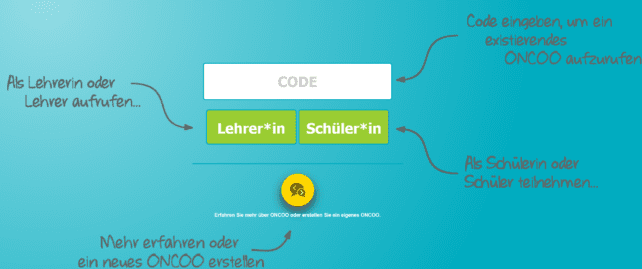
Screenshot of the Oncoo homepage showing the following options: “Enter a code to join an existing Oncoo session,” “Join as a teacher,” “Join as a student,” or “Learn more or create a new Oncoo session.”
ONCOO
The digital toolbox ONCOO offers you different methods for collaborative and interactive learning. From brainstorming to evaluation, it allows you to actively involve your students in the course. We will show you how the tool works.
Photo: Five people are standing in a row, holding empty speech bubbles in front of their faces.
Feedback in teaching
Since John Hattie’s meta-study “Visible Learning” was translated into German in 2013, one topic has become an integral part of the debate about our education system: feedback. But what is feedback and what is not?
Decorative picture: a wooden tower made of blocks, each with a smiling, neutral and sad face.
Why evaluate teaching – and how does that work with TAP?
For students to learn successfully, teaching must be appropriately designed. Likewise, students should take responsibility for their own learning process. This means that students themselves are very good at judging how teaching should be designed for them. For this reason, there are regular evaluations at the TH Cologne that make the quality of teaching visible…
Kahoot Teaser Video
Kahoot!
Repeat teaching content in a playful way, test knowledge or let your students create a quiz themselves. With Kahoot! you have many opportunities to activate your students and promote the learning process.
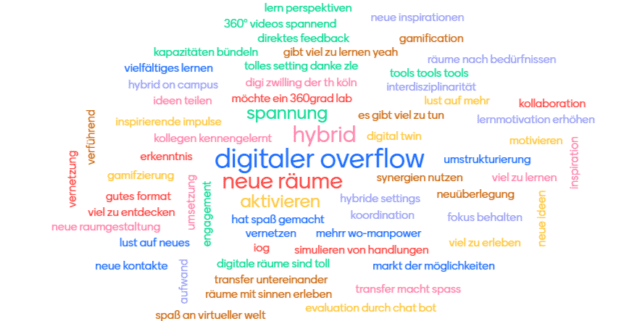
Mentimeter Header
Mentimeter
With Mentimenter, students can answer questions online or vote on issues – very easily and completely anonymously. Learn in this article how to use the tool to involve students interactively and in real time in your teaching.
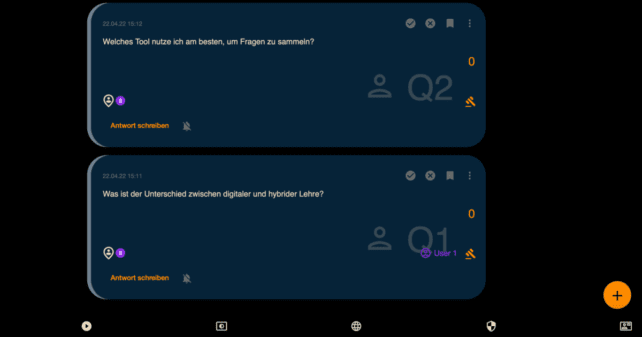
Screenshot. View of two questions that were asked anonymously through the app.
frag.jetzt
In the question rooms of frag.jetzt, students can ask questions anonymously without registering and only with a code. We explain how to set up and use the browser-based tool to break down inhibitions and answer questions for everyone.

We appreciate your feedback!

When developing this offer, we tried to include you as a teacher in advance. We would therefore be delighted if you would help us to further improve our offer. Please let us know what you would like, what bothers you or what you particularly like.

Would you like to contact us directly? Then write to us at lehrpfade@th-koeln.de!