


Motivation in teaching
Motivation is crucial for successful teaching and learning. But how can students be inspired to participate actively and independently in challenging learning processes? An effective didactic framework is necessary to encourage lively discussions and avoid passive behaviour. Key aspects include, for example, using a variety of methods, promoting personal responsibility and creating a motivating learning environment. The aim is to create an engaging learning atmosphere in which students are motivated and keen to participate in discussions, rather than passively following the class. Such an environment encourages initiative and active thinking.

In a nutshell
Students’ motivation is greatly influenced by your teaching environment, your communication style and how the course is integrated into the degree programme. Structure these factors in such a way as to encourage motivation and value independent learning. You cannot fully control motivation, as the responsibility ultimately lies with the students and some may still choose not to participate actively. However, it is important to avoid conditions that inhibit motivation. These include long monologues and confusing presentations that invite passive listening. Similarly, unclear assessment criteria and a lack of relationship building during face-to-face sessions can lead to students shying away from interaction and contributions to class.
Self-determination theory according to Deci and Ryan (1983)
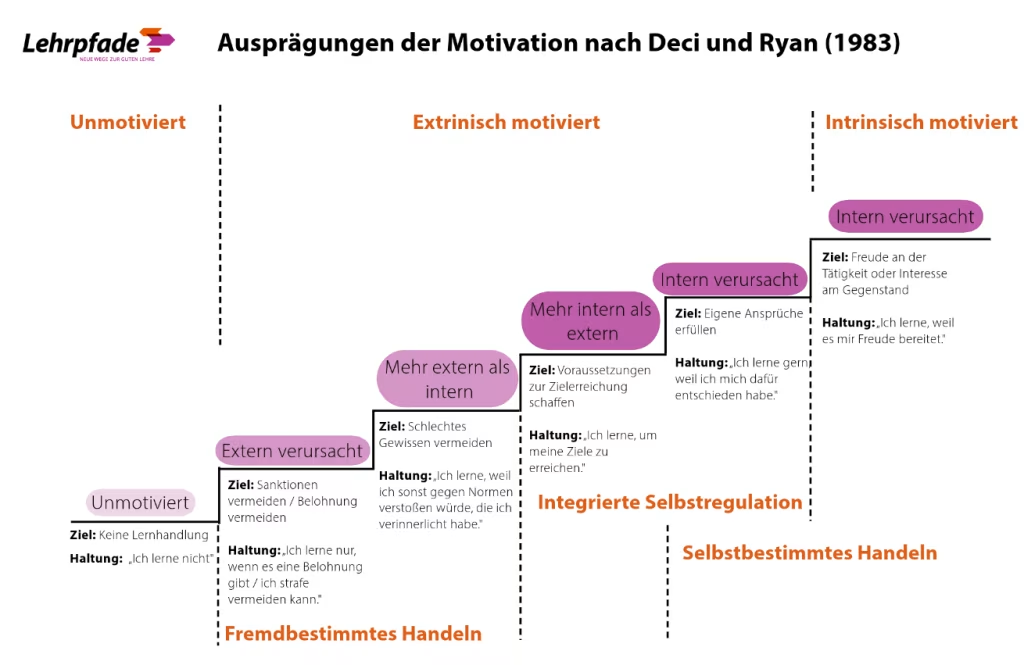
The self-determination theory developed by Edward Deci and Richard Ryan (1983) offers practical approaches to creating a motivation-enhancing environment in class. According to Deci and Ryan, the simple distinction between ‘extrinsic’ and ‘intrinsic’ motivation is not sufficiently nuanced. Whilst intrinsic motivation is the strongest driver – whereby students find an activity or topic fulfilling or interesting of their own accord and therefore engage with it – even less appealing tasks can be tackled in a self-determined manner. The theory divides the field of extrinsic motivation into four levels, which describe a continuum ranging from ‘extrinsically motivated behaviour’ to ‘intrinsically motivated behaviour’. The following figure illustrates this.
Intrinsic motivation
The word ‘intrinsic’ is derived from Latin and roughly means ‘from within’. Intrinsically motivated behaviour refers to behaviour driven by incentives inherent in the activity itself. Such an activity brings joy and pleasure and is perceived as interesting. Intrinsic motivation also means self-determined action.
Extrinsic motivation
The word ‘extrinsic’ too is derived from Latin and roughly means ‘from outside’. In the case of extrinsic motivation, it is not the action itself that acts as a motivator, but something external to the action. This often takes the form of goal-oriented motivation, that is, behaviour that serves an external goal and benefit rather than being an end in itself. Extrinsic motivation also means behaviour that is determined by external factors.
Video on extrinsic motivation (German)
Video on self-determination theory (German)
Enable motivation by…
This table contains further examples of measures that promote or hinder motivation (German).
Any questions?
Feel free to contact us by mail to lehrpfade@th-koeln.de!
Links & literature
Header image: AI-generated with Adobe Firefly